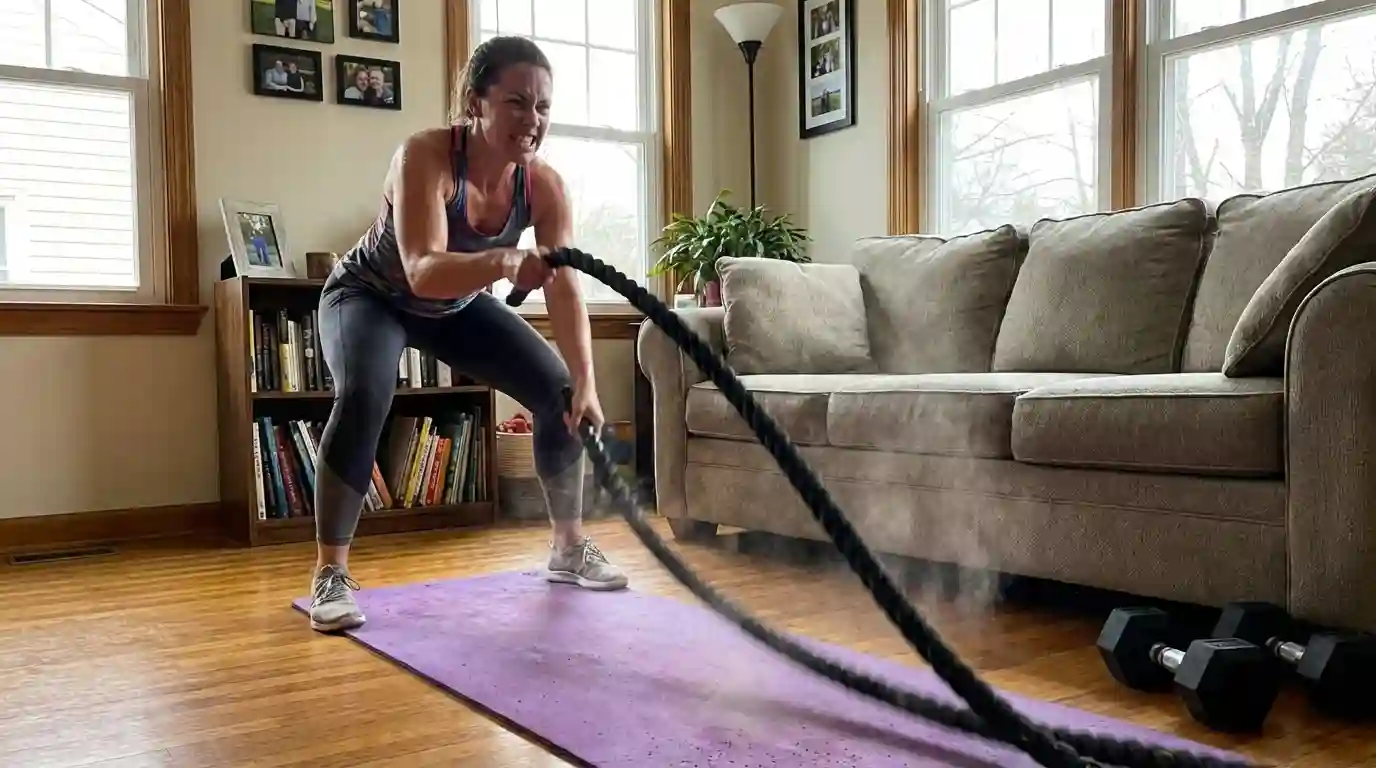
Battle ropes trigger a supra-maximal physiological response in a compressed timeframe. Because the movement relies on upper-body pressor responses combined with intense isometric core stabilization, it forces the cardiovascular system to work near its upper limits — placing it among the most metabolically demanding tools in modern conditioning.
The Metabolic Cost
Battle ropes trigger a supra-maximal physiological response in a compressed timeframe. Because the movement relies on upper-body pressor responses combined with intense isometric core stabilization, it forces the cardiovascular system to work near its upper limits. A benchmark study by Fountaine and Schmidt (2015) in the Journal of Strength and Conditioning Research measured the output of a standard 10-minute battle rope protocol (15 seconds work / 45 seconds rest).
| Physiological Parameter | Average Observed Value | Peak Observed Value |
|---|---|---|
| Heart Rate (bpm) | 141–148 | 162–178 |
| % of Max Heart Rate | 74.0%–79.0% | 87.0%–90.3% |
| VO2 (ml/kg/min) | 18.8–26.9 | 27.2–35.4 |
| Blood Lactate (mmol/L) | 7.9–9.8 | 11.7–13.6 |
| Energy Expenditure | 10.1 kcal/min | 14.1 kcal/min |
The Lactate Context: Typical competitive basketball gameplay elicits blood lactate levels around 6.8 mmol/L. A 30-minute battle rope session pushes that number to 13.6 mmol/L — forcing the body to rapidly clear hydrogen ions and utilize lactate as a fuel source.
Muscle Activation and Biomechanics
Surface Electromyography (EMG) shows that battle ropes are not just a shoulder isolation exercise. To generate the "Dual Force Dynamic Effect" — stabilizing against gravity while generating a wave — requires multi-planar core integration. Activation levels above 40% of Maximal Voluntary Isometric Contraction (MVIC) are clinically sufficient to build strength. Battle ropes consistently exceed this threshold across the kinetic chain.
| Muscle Group | Highest Activation Exercise | Activation (%MVIC) | Function |
|---|---|---|---|
| Anterior Deltoid | Double Arm Wave/Slam | 51%–73% | Shoulder stability |
| External Oblique | Unilateral (Alternating) Wave | >51% | Anti-rotational core strength |
| Erector Spinae | Double Arm Slam | >40% | Spinal stability |
| Vastus Medialis/Glutes | Double Arm Slam | >40% | Lower body power |
Note: Unilateral (alternating) waves force a 20% increase in external oblique activation because the core must resist asymmetric rotational forces. Bilateral slams shift the load to the erector spinae and posterior chain for triple extension.
For a deeper dive into posterior chain mechanics, read our guide on The Kettlebell Swing: Biomechanics and Muscle Activation Data.
Practical Programming Constraints
Ropes are concentric-only. There is no eccentric "lowering" phase to cause severe muscle tissue damage. This allows for high-frequency training with lower recovery penalties than heavy barbell work. However, the acute metabolic fatigue they generate dictates when they should be used.
The Interference Effect
Data from Division-1 athletes shows that a 30-minute battle rope session immediately prior to skill-based sports practice causes a 16.9% decrease in shooting accuracy and a 9.1% drop in pass speed. Always schedule battle rope training after technical skill work.
Standard Protocols
- Strength Endurance: 30 seconds work / 30 seconds rest (3–5 rounds at RPE 8). Stresses the glycolytic pathway.
- Power Output: 10 seconds maximum effort / 50 seconds rest. Relies on the ATP-CP (phosphagen) system, allowing near-complete replenishment between sets.
If you want to combine battle ropes with a full conditioning program, see our Stair Stepper HIIT Protocols guide for complementary cardio programming.
Technical Corrections for Efficiency
- Tension Mechanics: Do not pull the rope tight. A taut rope restricts range of motion and kills wave amplitude. Ensure 1–3 feet of slack between you and the anchor point.
- Grip: Avoid the "death grip." Squeezing the rope maximally burns out the forearms prematurely, forcing you to stop before the larger back and leg muscles are fatigued.
- Posture: Maintain a neutral spine. Excessive hip flexion ("taco position") shuts down core recruitment and shifts the mechanical load entirely to the lumbar spine.
Key Takeaways
- Battle ropes burn 10.1–14.1 kcal/min — one of the highest metabolic outputs of any upper-body exercise
- Blood lactate reaches 13.6 mmol/L, exceeding competitive basketball intensity
- Anterior deltoid activation: 51–73% MVIC; external oblique: >51% MVIC
- Use unilateral waves for core; bilateral slams for posterior chain
- Never program before technical sports practice (causes 16.9% skill drop)
- Keep 1–3 feet of slack; avoid the death grip; maintain neutral spine