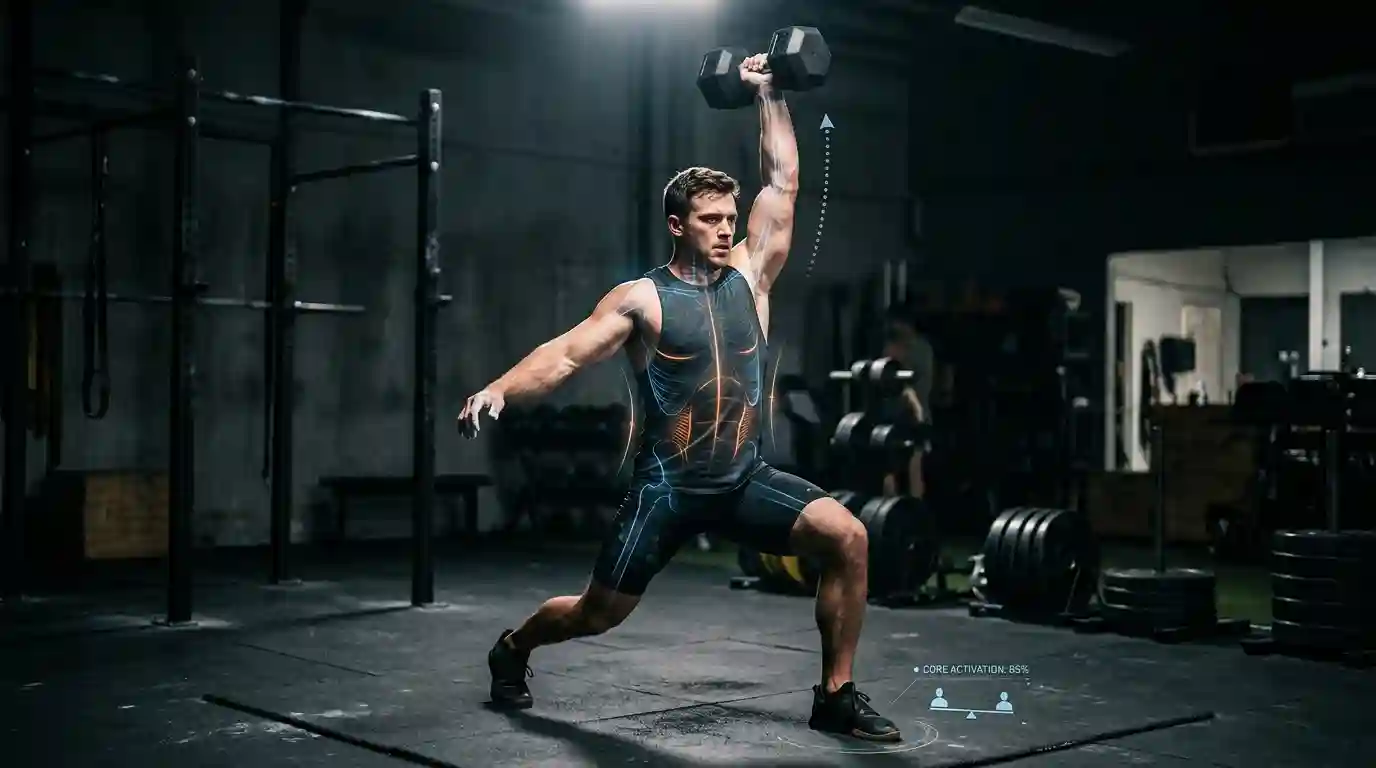
The barbell has dominated strength training culture for a century. And for good reason — bilateral compound lifts build raw force. But if you've ever noticed your dominant side doing more than its share, or felt that familiar asymmetrical tweak, you've run headlong into the limits of bilateral-only training. The solution isn't to abandon the barbell — it's to stop ignoring the neuroscience of unilateral loading.
The Science of the "Bilateral Deficit"
For decades, the "Big Three" (Squat, Bench, Deadlift) have reigned supreme. But if you've noticed your right side doing 60% of the work during a heavy set, or felt a "tweak" in your lower back during a standard squat, you're hitting the limits of bilateral training. The human body is an asymmetrical organism built for single-limb stability — whether sprinting for a bus or pivoting on a pitch, you operate unilaterally.
Research reveals a fascinating neurological quirk: the Bilateral Deficit — the physiological fact that the sum of force produced by each limb independently is often higher than the force produced by both limbs together. The mechanism is primarily neural: when both limbs train simultaneously, the CNS partially inhibits force output in each limb, a phenomenon called "bilateral neural inhibition." By switching to unilateral movements, you're not just "fixing imbalances" — you're accessing a higher percentage of your muscle's true force potential. The deficit is most pronounced in explosive movements and less pronounced in slow, grinding strength work — which is why unilateral training is especially critical for athletic populations.
Key Physiological Benefits
- The Cross-Education Effect: Training your right leg actually keeps your left leg strong. Neural pathways stimulated on one side "leak" to the other — a literal lifesaver during injury rehab. Immobilization studies show that subjects who train only the uninjured limb maintain 30–50% more strength in the injured limb compared to complete rest. (Source: Journal of Applied Physiology)
- Anti-Rotational Core Power: When you hold a dumbbell in one hand during a walking lunge or single-arm press, your obliques and transverse abdominis must fire at close to 100% capacity to prevent lateral tipping. This is real-world functional core strength that no bilateral exercise replicates.
- Pelvic Realignment: Single-leg work forces the gluteus medius to stabilize the pelvis, correcting "hip hiking" (lateral pelvic tilt) that causes chronic lower back pain. Bilateral squatting doesn't load the gluteus medius sufficiently because the pelvis is balanced across both legs. (Source: International Journal of Sports Physical Therapy)
Anti-rotational core activation is also a hallmark of the battle rope alternating wave — where unilateral loading forces >51% MVIC external oblique activation. The two modalities are highly complementary.
Why Hexagonal Geometry Matters
The choice between round and hexagonal dumbbells isn't just aesthetic — it's a functional engineering decision that determines which exercises are safe and which become injury risks.
| Feature | Hexagonal Dumbbells | Round-Head Dumbbells |
|---|---|---|
| Stability | Anti-roll; acts as a floor-based anchor | Prone to rolling; dangerous for floor work |
| Exercise Versatility | High (Renegade rows, DB push-ups) | Low (Limited to standard lifts) |
| Safety | Stationary on uneven surfaces | Hazard in high-traffic or home gyms |
| Grip/Ergonomics | Fixed, knurled handles | Often features rotating sleeves |
For movements like the Renegade Row — where you hold a plank on the dumbbells while rowing — hex weights are non-negotiable. Using round weights for these moves is a recipe for wrist injury. The hex face creates a stable, flat contact point between the dumbbell and the floor, allowing you to load the movement correctly without fighting instability.
The "Weak Side Rule": How to Program for Symmetry
Acknowledging an imbalance and actually training to correct it are two different things. Most athletes train both sides equally — which perpetuates the gap, since the strong side continues to dominate at higher volumes. If you want to fix asymmetries, you cannot train both sides equally. Follow the Ian King Method:
- Start with the Weak Side: Always perform your first set on your non-dominant or weaker limb while your CNS is fresh and fully recovered. Fatigue systematically disadvantages the weaker side if it goes second.
- Match, Don't Exceed: If your weak left leg completes 8 reps at a given weight, your strong right leg only does 8 reps — even if it could do 12. Every rep the strong side takes that the weak side doesn't is another rep of asymmetry reinforcement.
- The Volume Gap: For severe imbalances (>20% strength difference), add one extra set to the weak side only (e.g., 4 sets left leg, 3 sets right leg). Over 8–12 weeks, this targeted overload closes the gap without overtraining the stronger limb.
This strength imbalance correction approach directly impacts athletic performance. Read how it applies to vertical power development in Beyond the Bounce: The Physics of Elite Vertical Power — particularly the single-leg eccentric loading required for safe depth jump training.
Recommended Loads by Goal
| Goal | Intensity (% 1RM) | Reps | Sets | Rest |
|---|---|---|---|---|
| Max Strength | >85% | 1–5 | 3–6 | 3–5 min |
| Hypertrophy | 70–85% | 8–12 | 3–4 | 60–90 sec |
| Endurance | <60% | 15+ | 2–3 | <30 sec |
The future of longevity and athletic performance isn't found in chasing a higher bilateral total, but in mastering the chaos of asymmetrical loads. By integrating hexagonal dumbbells into your routine, you bridge the gap between "gym strength" and "functional survival" — the kind of strength that holds up when the ground is uneven and the load is unpredictable.
Key Takeaways
- Bilateral Deficit: each limb trained independently often produces more total force than both limbs together — due to bilateral neural inhibition
- Cross-Education Effect: training one limb maintains 30–50% more strength in an immobilized limb compared to complete rest
- Hex dumbbells are non-negotiable for renegade rows, DB push-ups, and floor-based plyo work
- Start every unilateral session with the weak side while the CNS is fresh
- Match reps: the strong side never exceeds the weak side's volume in the same session
- For severe imbalances (>20%), add 1 extra set to the weak side only for 8–12 weeks