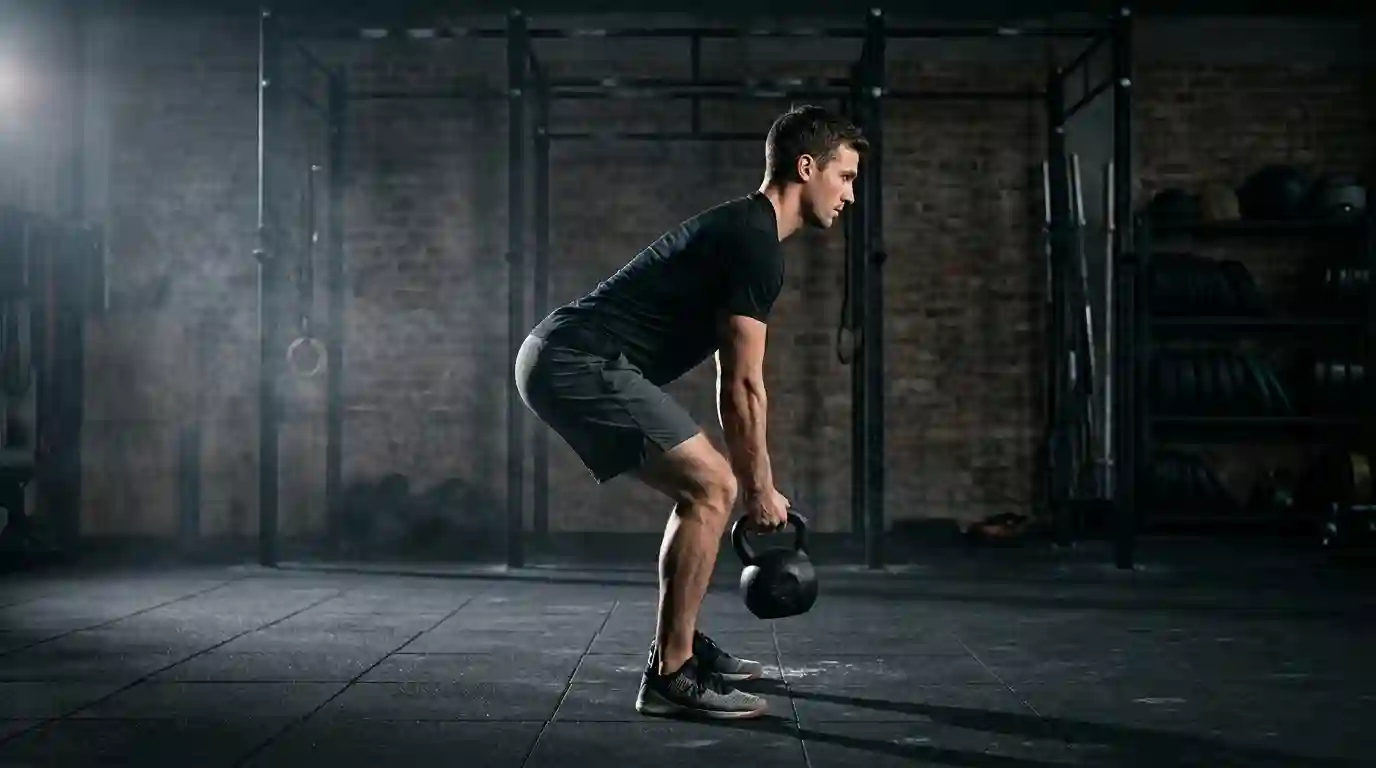
The kettlebell swing is simultaneously the most misunderstood and most undervalued exercise in strength training. Coaches argue about it, athletes butcher it, and gym-goers avoid it. The data, however, is unambiguous: when performed correctly, the swing produces near-maximal posterior chain EMG activation using a fraction of the spinal load of a conventional deadlift — making it one of the highest return-on-investment movements in existence.
Muscle Activation Profiles (EMG Data)
The kettlebell swing is a ballistic, multi-joint hip hinge. It relies on horizontal force vectors to maximize posterior kinetic chain recruitment while minimizing knee flexion. Surface EMG data demonstrates that the swing elicits high muscle activation using relatively light external loads (e.g., 16 kg) — the ballistic acceleration phase creates a high effective load through momentum and rate of force development. Critically, the hamstrings (specifically the biceps femoris) initiate the movement, refuting the clinical assumption that glutes must fire first in hip extension patterns.
| Muscle Group | Peak %MVIC (Average) | Phase of Peak Activation |
|---|---|---|
| Biceps Femoris | 78.9% | Initial propulsion phase |
| Gluteus Maximus | 75%–76.1% | Terminal hip extension (57% of cycle) |
| Gluteus Medius | 55.5%–70.1% | Hip extension and stabilization |
| Erector Spinae | ~50% | Isometric stabilization throughout cycle |
At 78.9% MVIC, the biceps femoris during a kettlebell swing approaches the activation levels seen during maximal sprinting — using a fraction of the load. This makes the swing an extraordinarily efficient tool for developing hamstring strength in populations where heavy barbell training is contraindicated.
For comparison, see how battle rope training activates the external oblique at >51% MVIC — read The Science of Battle Ropes: Muscle Activation Data.
Spinal Mechanics and Loading
Traditional compressive lifts (squats, deadlifts) load the spine axially — compressing the vertebral column from above. The kettlebell swing introduces posterior shear forces at the lumbar spine, specifically pulling the L4 vertebra on the L5 vertebra. Understanding the magnitude of these forces contextualizes why the swing is frequently recommended for individuals with lumbar concerns who cannot tolerate heavy axial loading.
- Axial Compression (Heavy Deadlift): >17,000 N
- Posterior Shear (16kg Swing): <3,200 N
The "Kime" Effect
Introducing a brief muscular pulse ("kime") at the apex of the swing — a simultaneous glute squeeze, abdominal brace, and lat engagement at the top of the movement — increases spinal compression from 1,903 N to 2,960 N. This intentional increase in compressive force activates more stabilizing musculature and increases the training stimulus without altering the fundamental kinematics of the movement. This is an advanced technique for lifters seeking to maximize muscle engagement once baseline mechanics are solid.
Source: McGill, S. M., & Marshall, L. W. (2012). Journal of Strength and Conditioning Research, 26(1), 16–27.
Biomechanical Classification: Hinge vs. Squat
The single most common technical error in the kettlebell swing is squatting the movement. Failing to differentiate a hinge from a squat during the swing doesn't just reduce efficiency — it shifts the force vector from the intended horizontal/posterior direction to a vertical direction, dramatically increasing shear force on the knee and reducing posterior chain recruitment.
| Metric | Authentic Hip Hinge | Squat Compensation |
|---|---|---|
| Primary Lever | Hip | Knee |
| Force Vector | Horizontal (Posterior-Anterior) | Vertical (Inferior-Superior) |
| Center of Mass | Shifted backward | Dropped downward |
| Tibial Angle | Near vertical | Forward incline |
The swing is a hinge, not a squat. If the kettlebell is swinging between your knees (rather than between your thighs), your tibial angle is too far forward — you are squatting the swing and losing posterior chain drive entirely. The hips should travel back, not down.
Posterior chain strength is also the foundation of vertical power. Read our analysis of the Stretch-Shortening Cycle and plyometric training to understand how hip extension power from the swing transfers directly to athletic jumping and sprinting performance.
Unilateral vs. Bilateral Dynamics
Moving from a two-handed to a one-handed swing introduces asymmetrical loads that shift the demand profile from sagittal plane stability to anti-rotation and frontal plane stability. The changes in muscle activation are significant and make single-arm swings a distinct training stimulus rather than simply a harder version of the two-handed swing.
- Contralateral Erector Spinae: Activation is 14–25% higher on the side opposite the kettlebell. The erector on the non-kettlebell side must work maximally to resist the lateral flexion and rotational torque introduced by the unilateral load.
- Rectus Abdominis: Activation is 40–59% higher during two-handed swings, as bilateral loading demands maximal anterior bracing through the full range of the movement cycle. The single-arm swing trades anterior bracing for anti-rotational demand.
The anti-rotational demand of the single-arm swing mirrors the unilateral training principles discussed in Beyond the Barbell: Unilateral Hex Training — where asymmetric loading is used intentionally to develop functional core strength that bilateral exercises cannot replicate.
Metabolic Cost and Performance Outcomes
The swing presents a characteristic mismatch between oxygen consumption and heart rate that is typical of high-intensity multi-joint resistance training. Heart rate rises disproportionately relative to VO2 — a phenomenon driven by the high isometric muscle tension and cardiovascular pressor response from the posterior chain engagement rather than purely aerobic demand.
- Heart Rate: 87–90% of HRmax during 12 minutes of continuous swings
- VO2 Max: ~65% of VO2 max — significantly below the heart rate percentage, confirming the pressor-driven cardiac response
- Caloric Expenditure: 12.5–13.6 kcal/min (plus EPOC adds 55–200 total post-training calories depending on session volume)
- Strength Impact: 6 weeks of kettlebell training yields ~2% increase in vertical jump, comparable to traditional weightlifting — though barbell training remains superior for absolute 1RM gains (14% vs. 4%)
- Ground Reaction Forces: During an 8 kg swing, GRF can exceed those generated during a 32 kg deadlift in specific populations, due to the rate of force development required in the ballistic propulsion phase
Source: Lake, J. P., & Lauder, M. A. (2012). Journal of Strength and Conditioning Research, 26(8), 2228–2233.
Key Takeaways
- Biceps femoris fires first at 78.9% MVIC — the kettlebell swing is a hamstring-dominant, hip hinge movement
- Spinal shear: <3,200 N (16kg swing) vs. >17,000 N (heavy deadlift) — significantly lower axial joint stress
- The swing is a horizontal-force hinge, NOT a vertical squat — tibial angle must stay near vertical; hips travel back, not down
- Single-arm swing: 14–25% higher contralateral erector spinae activation for anti-rotational core development
- 12.5–13.6 kcal/min metabolic output plus significant EPOC for extended post-exercise caloric burn
- 8 kg swing GRF can exceed a 32 kg deadlift due to rate of force development — ballistic loading creates high effective loads with low absolute weight